

企业QQ

官方微信

Thankyouforvisitingnature.com.YouareusingabrowserversionwithlimitedsupportforCSS.Toobtainthebestexperience,werecommendyouuseamoreuptodatebrowser(orturnoffcompatibilitymodeinInternetExplorer).Inthemeantime,toensurecontinuedsupport,wearedisplayingthesitewithoutstylesandJavaScript.
Receptor-interactingprotein(RIP)3isacriticalregulatorofnecroptosisandhasbeendemonstratedtobeassociatedwithvariousdiseases,suggestingthatitsinhibitorsarepromisingintheclinic.However,therehavebeenfewRIP3inhibitorsreportedasyet.B-RafV600Einhibitorsareanimportantanticancerdrugclassformetastaticmelanomatherapy.Inthisstudy,wefoundthat6B-RafinhibitorscouldinhibitRIP3enzymaticactivityinvitro.Amongthem,dabrafenibshowedthemostpotentinhibitiononRIP3,whichwasachievedbyitsATP-competitivebindingtotheenzyme.DabrafenibdisplayedhighlyselectiveinhibitiononRIP3overRIP1,RIP2andRIP5.Moreover,onlydabrafenibrescuedcellsfromRIP3-mediatednecroptosisinducedbythenecroptosis-inducedcombinations,thatis,tumornecrosisfactor(TNF)伪,TNF-relatedapoptosis-inducingligandorFasligandplusSmacmimeticandthecaspaseinhibitorz-VAD.DabrafenibdecreasedtheRIP3-mediatedSer358phosphorylationofmixedlineagekinasedomain-likeprotein(MLKL)anddisruptedtheinteractionbetweenRIP3andMLKL.Notably,RIP3inhibitionofdabrafenibappearedtobeindependentofitsB-Rafinhibition.Dabrafenibwasfurtherrevealedtopreventacetaminophen-inducednecrosisinnormalhumanhepatocytes,whichisconsideredtobemediatedbyRIP3.Inacetaminophen-overdosedmousemodels,dabrafenibwasfoundtoapparentlyeasetheacetaminophen-causedliverdamage.TheresultsindicatethattheanticancerB-RafV600EinhibitordabrafenibisaRIP3inhibitor,whichcouldserveasasharptoolforprobingtheRIP3biologyandasapotentialpreventiveortherapeuticagentforRIP3-involvednecroptosis-relateddiseasessuchasacetaminophen-inducedliverdamage.
Necroptosis,alsoknownasprogrammednecrosis,isakindofprogrammedcelldeaththatoccursatconditionsthatresultinblockingtheexecutionofapoptosis.1,2Theproteinkinasereceptor-interactingprotein(RIP)3isaserine/threonineproteinkinasethathasrecentlybeendemonstratedtobethecriticalregulatorthatswitchescellsfromapoptosistonecroptosis.3,4,5,6Thedeathreceptorligands,suchastumornecrosisfactor(TNF)伪,FasligandandTNF-relatedapoptosis-inducingligand(TRAIL),areclassicalinducersofapoptosisornecroptosis.Bybindingtotheirrespectivereceptors,theyleadtoactivationoffunctionalcaspase-8,whichresultsinapoptosisbyactivatingtheeffectorcaspasessuchascaspase-3butinactivatingthenecroptickinasessuchasRIP3.Whencaspase-8isabsentorinhibitedbycaspaseinhibitorssuchasz-VAD,thosedeathreceptorligandscausenecroptosis,whichcanbeaugmentedbySmacmimeticthatpromotesdegradationofinhibitorofapoptosisproteins.3,4,5,6
RIP3iswidelyinvolvedinphysiologicalprocessesandpathologicalstates.6RIP3deficiencynotonlyrescuesthelethalityofcaspase-8鈭?鈭?/sup>andFADD鈭?鈭?/sup>mice7andrestoresnormalproliferationoftheirTcells,6butalsoprotectshepatocytesfromethanol-inducedinjuryandsteatosis,8rescuescaspase-8orFADDdeficiency-inducedmassiveinflammationinepithelium,9preventscerulean-inducedacutenecrotizingpancreatitis,3,4inhibitsphotoreceptorandconecelldeath10,11andalleviatesmacrophagenecrosisinadvancedatherosclerosislesions.12Acetaminophenisanextensivelyusedanalgesicandantipyretic.Whentakeninoverdose,itsmostfrequenttoxicityishepatotoxicityincludingfatalcentrilobularhepaticnecrosis.13,14AcetaminophenoverdoseisthemostcommoncauseofacuteliverfailureintheUnitedStatesandtheUnitedKingdom.15Italsocauses11.86%ofacuteliverfailureinChina.16Enhancedlevelsofhigh-mobilitygroupbox-1andnecrosiskeratin-18markedoccurrenceofhepaticnecrosis.14Necrosishasbeenconsideredasthepredominantmodeofcelldeathinthiscase,forwhichRIP3hasbeenshowntoberesponsible.17Inaddition,RIP3mightalsobeassociatedwithcarcinogenesisandtumordrugresistancetochemotherapeutics.18,19Theselinesofevidencesuggestpotentialextensiveusesofsmall-moleculeRIP3inhibitorsinmedicalpreventionortherapy.
However,fewRIP3inhibitorshavebeenreported20andnosmall-moleculeRIP3inhibitorshavebeeninvestigatedforthepotentialmedicaluses.OnepossiblecauseisthattherelacksaproperRIP3kinaseassayforscreeningforitsinhibitorsatmolecularlevels,whichshouldbehighlysensitive,freeofradioisotopes,andhighthroughput.Wethusestablishedanon-radioactiveluminescentRIP3kinaseassayinthisstudy.Byusingthisassay,wefoundthat6B-RafinhibitorsinhibitedtheRIP3enzymaticactivityinvitro.ButonlydabrafenibcouldrescuecellsfromRIP3-mediatednecroptosisinducedbyTNF伪,TRAILorFasligandplusSmacmimeticandthecaspaseinhibitorz-VAD.DabrafenibdirectlyandATP-competitivelyboundtoRIP3proteinandcausedhighlyselectiveinhibitiononRIP3overRIP1,RIP2andRIP5.Dabrafenibwasdemonstratedtoeaseacetaminophen-inducednecrosisinnormalhumanhepatocytesandtopreventacetaminophen-inducedliverinjuryinmice.OurstudyraisesapossibilitythatthemedicalindicationsoftheB-RafV600EinhibitordabrafenibmightbeextendedfromcancerstoRIP3-involveddiseases.
ResultsEstablishmentofanon-radioactiveluminescentRIP3kinaseassayToevaluatetheRIP3inhibitionofcompoundsatthemolecularlevel,weestablishedanon-radioactiveluminescentRIP3kinaseassay(SupplementaryFigure1)byexpressingthefull-lengthhumanRIP3proteinwithaglutathioneS-transferase(GST)tagasshownschematicallyinSupplementaryFigure1a.Toensurethereproducibilityoftheassayandmakeitfitforhigh-throughputscreening,weoptimizedthereactionconditions(SupplementaryFigures1b鈥揻).OneunitoftherecombinantRIP3enzymaticactivitywasdefinedasitsamountrequiredtoconsume100鈥塶MATPina10-渭lreactionsystemcontainingthesubstratemyelinbasicprotein(MBP,25鈥塶g/渭l)at30鈥壜癈for90鈥塵in.Themaximalsignal-to-noiseratioofthisassaycouldbeachievedwhenRIP3wasusedatbetween50鈥塙and75鈥塙(SupplementaryFigure1b).TheATPconsumptionreacheditsmaximumatabout25鈥塶g/渭lofMBP(SupplementaryFigure1c).TheATPconcentrationandconsumptionrelationshipcurvehaditsmaximalslopeatbetween5and13鈥?i>渭MofATPwiththeKmvalueof12.58鈥?i>渭MforATP(SupplementaryFigure1d).Thereactionpercentagereachedaplateauatbetween20and35鈥壜癈for90鈥塵in(SupplementaryFigures1eandf).Accordingtotheseresultsandconsideringtheoperability,theassaywassettoberunat30鈥壜癈for90鈥塵inina10-渭lsystemcontaining50鈥塙oftherecombinantRIP3enzyme,25鈥塶g/渭lofthesubstrateMBPand10鈥?i>渭MofATP.
TheactivityofourrecombinantRIP3wassimilartothatoftheenzymefromAbcamwiththeKmvaluesof28.83and30.59鈥塶g/渭l,respectively(SupplementaryFigures1cand2a).Moreover,thesensitivityofthisnon-radioactiveluminescentRIP3kinaseassaywasalsosimilartothatoftheradioactiveRIP3kinaseassayperformedbytheReactionBiologyCorporation(Malvern,PA,USA;Table1).
Table1TheinhibitoryactivityofthecompoundsagainstRIP3andRafsFullsizetableTheB-RafinhibitordabrafenibselectivelyinhibitsRIP3kinaseactivitybyitsATP-competitivebindingtotheenzymeproteinBasedontheprimarysequencesimilaritybetweenRIP3andRIP1proteinsandtheconformationalsimilaritybetweenRIP1andB-Rafproteins,21wetested10commerciallyavailableproteinkinaseinhibitorsinthisassay,includingeightB-Raf/B-RafV600Einhibitors,necrostatin-1(RIP1inhibitor)21,22andSU11248(tyrosineproteinkinaseinhibitor;Table1andSupplementaryFigure2b).TheresultshowedthatthesixtestedB-Rafinhibitors(dabrafenib,AZ628,regorafenib,PLX4720,vemurafenibandsorafenib)inhibitedtheRIP3activitywithIC50srangingfrom0.25to14.52鈥?i>渭M,buttheothertwoB-Rafinhibitors(GDC-0879andSB590885),necrostatin-1andSU11248didnot(Table1andSupplementaryFigure2b).Theresultswerefurtherconfirmedbyaclassicalradioactiveassay,whichgavethesimilardataofRIP3inhibition(Table1).BothassaysrevealedthatdabrafenibhadthemostpotentRIP3inhibitoryactivitywiththelowestIC50samongallthosetestedcompounds.SelectivityanalysesagainsttheRIPfamilymembersrevealedthatdabrafenibinhibitedRIP326鈥?00-,38-and14鈥?75-foldmorepotentlythanRIP1,RIP2andRIP5,respectively(Figure1a).
Figure1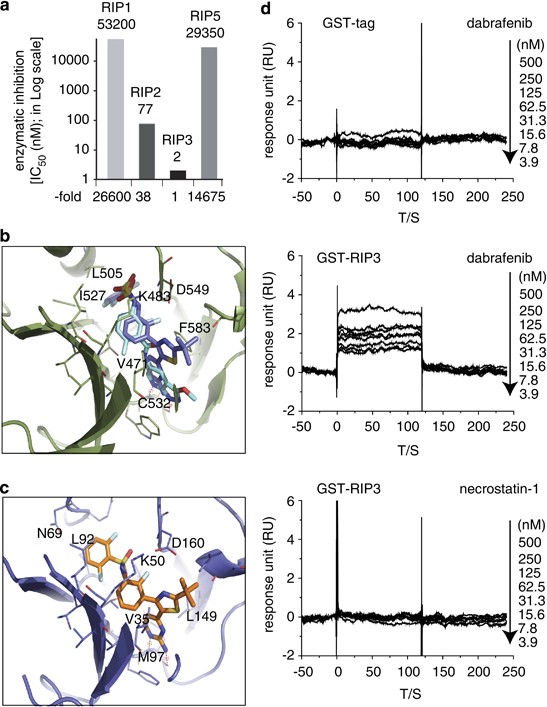
DabrafenibselectivelyinhibitsRIP3enzymaticactivitybybindingtotheenzymeprotein.(a)TheinhibitionofdabrafenibagainstRIP1鈭?/span>RIP3andRIP5wasexaminedbytheradioactiveassay(ReactionBiologyCorporation).Column,themeanoftheIC50valuesfromtwoindependentexperiments.TherelativefoldwasobtainedbynormalizingtheIC50valueforRIP3as1.(b)MoleculardockingofdabrafenibbindingtoB-Raf.TheB-Rafproteinwasshownasacartoonstyle,theoriginalligandin3SKCwascoloredcyananddabrafenibwascoloredmarineblue.(c)MoleculardockingofdabrafenibbindingtoRIP3.RIP3wasshownincartoonanddabrafenibwasshowninthestickmodel.(d)ThesurfaceplasmonresonanceassayshowedthatdabrafenibdidnotbindtotheGSTtagprotein(upper)butboundtotherecombinantRIP3protein(middle).TheRIP1inhibitornecrostatin-1didnotbindtoRIP3(lower).Therepresentativedatawereshownfromtwoindependentexperiments
FullsizeimageWenextinvestigatedthepossibilityofthedirectinteractionbetweendabrafenibandRIP3.Forthispurpose,weexploredtheinteractionbetweendabrafenibandB-Raf.BycheckingtheB-RafcrystalstructuresdepositedinPDBdatabase,wefoundthecrystalstructure3SKC23containingaligandwithhighsimilaritytodabrafenib.ThemoleculardockingstudywasconductedtoobtainthebindingmodeofdabrafenibattheATPsiteofB-Raf.SimilartotheinteractionseeninthecrystalstructureofB-Raf(3SKC),dabrafenibboundtotheATP-bindingsiteofB-Rafbyutilizingthepyrimidin-2-aminegroupforminghydrogenbondswiththehingepart.Itssulfonamidegroupextendedtothesub-pocketinthevicinityoftheC-alphahelixofB-Raf,andsuperimposedwellwiththeoriginalligandin3SKC(Figure1b).ForthedockingstudyonthebindingofdabrafenibtoRIP3,weperformedthehomologymodelingofhumanRIP3basedontheB-Rafcrystalstructure3SKC.ThenthistheoreticalmodelofRIP3wasusedasthereceptortodockdabrafenibintoitsATP-bindingsite.TheresultshowedthatdabrafenibcouldbefitintothebindingpocketofRIP3verywell(Figure1c).Althoughtheinteractionpatternofthepyrimidin-2-aminegroupwiththehingeresidueM97issimilartoB-Raf,the2,6-difluorobenzenesulfonamidegroupofdabrafenibbindstoadifferentsub-pocketwhencomparedwiththepredictedB-Raf-dabrafenibcomplexstructure(Figure1b).ThedatasuggestthatdabrafenibcoulddirectlybindtoRIP3.
Toconfirmtheresult,wethenconductedthesurfaceplasmonresonancebiochemicalanalysiswithnecrostatin-1asthenegativecontrol.DabrafenibdidnotbindtotheGSTtagintherecombinantRIP3protein(Figure1d,upperpanel),excludingitsinfluenceontheassayforthebindingofdabrafenibtoRIP3.Dabrafenib(Figure1d,middlepanel),butnotnecrostatin-1(Figure1d,lowerpanel),couldbindtotherecombinantRIP3proteininaconcentration-dependentmannerwithadissociationconstant(Kd)valueof26.5鈥塶M.Lineweaver-BurkplotsbasedonthesubstrateATPcompetitionassayrevealedthatdabrafenibwascompetitivewithATPtoinhibittheRIP3kinaseactivity(SupplementaryFigure2c),furthersupportingtheconclusionaboutitsdirectbindingtotheprotein.
DabrafenibrescuescellsfromtheRIP3-mediatednecroptosisTNF伪plusSmacmimeticandthecaspaseinhibitorz-VAD(TSZ)isaclassicalcombinationthatisusedtoinduceRIP3-mediatednecroptosis.3,4,5WetreatedRIP3-expressedHT29cells(SupplementaryFigure3a)withthiscombinationandeightcompoundsthatinhibitedtheRIP3kinaseactivityinvitro.OnlydabrafenibwasfoundtorescueTSZ-causedcelldeathsignificantly(Figure2a).DabrafenibalsopreventedtheTSZ-inducednecroticmorphologysuchascellswelling,lossofmembraneintegrityandcelldisruptioninHT29cells(Figure2b).EitherTSZorTSZplusdabrafenibdidnotobviouslyaffectthecellviabilityofRIP3-deficientAcells3orshRIP3Ncells;incontrast,TSZapparentlyreducedthecellviabilityofRIP3-proficientNcells,3whichwaseffectivelyrestoredbydabrafenib(Figure2c).ThedatafurtherrevealedtheRIP3dependenceofdabrafenibinpreventingTSZ-inducednecroptosis.InRIP1-andRIP3-expressedHT29andU937cells4,24(SupplementaryFigure3a)exposedtoTSZ,dabrafenibratherthanthetyrosineproteinkinaseinhibitorSU11248,25restoredthecellviabilityaseffectivelyastheRIP1inhibitornecrostatin-1did(Figure2d).However,dabrafenibdidnoteaseapoptosisinducedbyTNF伪plusSmacmimetic(TS)inHT29cells(SupplementaryFigures3bandc),4furtherindicatingthatdabrafenibspecificallyinhibitedthenecroptosispathway.Moreover,dabrafenibratherthananotherclinicallyusedB-Rafinhibitorvemurafenib(withpoorRIP3inhibitoryactivity)reversedthelossofpropidiumiodide(PI)-negativeHT29cellscausedbyTSZ(SupplementaryFigures3d).InadditiontoTNF伪,othercytokinessuchasTRAILandFasligandhavealsobeenshowntobeabletoinducenecroptosis.4SowetestedwhetherdabrafenibcouldblockeitherTRAILorFasligand-inducednecroptosis.TheresultshowedthatdabrafenibreversedthereductionoftheHT29cellviabilityinducedbyTRAILorFasligandplusSmacmimeticandz-VAD(SZ;Figure2e).ThedatafurtherstrengthentheevidencethatdabrafenibactsasaRIP3inhibitor.
Figure2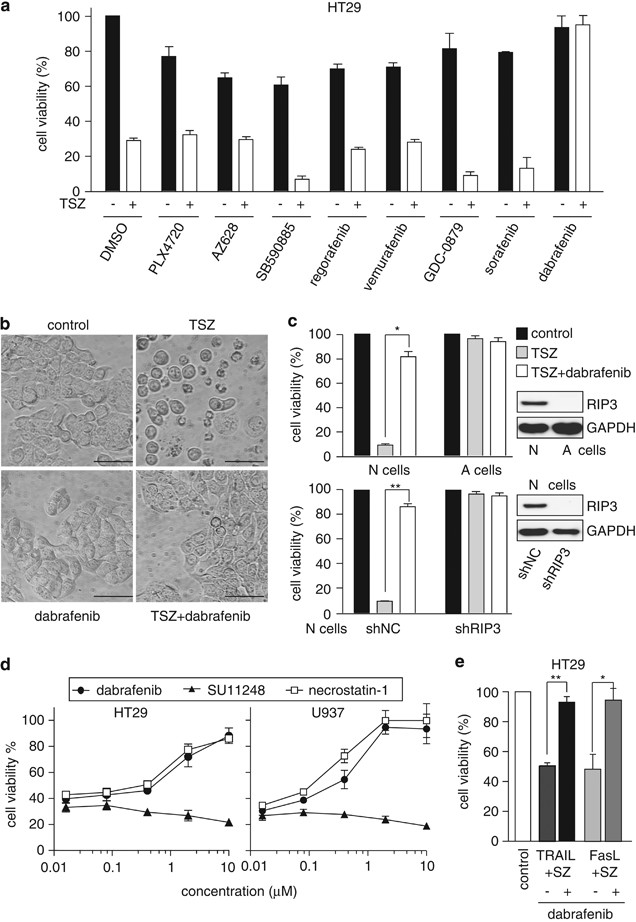
DabrafenibinhibitsRIP3-mediatednecroptosis.(a)CellviabilitywasexaminedinHT29cellswithorwithoutTNF伪(20鈥塶g/ml)plusSmacmimetic(100鈥塶M)andthecaspaseinhibitorz-VAD(20鈥?i>渭M;TSZ)inthepresenceoftheindicatedcompounds(dabrafenib,10鈥?i>渭M;alltheothers,100鈥?i>渭M)for24鈥塰.(b)HT29cellsexposedtoTSZfor24鈥塰inthepresenceorabsenceof10鈥?i>渭Mdabrafenibwereobservedunderaninvertedmicroscopeat20脳magnification.Scalebar,50鈥?i>渭m.Thedatawererepresentativeofthreeindependentexperiments.(c)ThecellviabilityofNandAcells(upperpanel)ortheRIP3-silencedNcells(lowerpanel)exposedtoTSZorTSZplusdabrafenibfor24鈥塰wasdetermined.TheproteinlevelsofRIP3inthecellswereexaminedbywesternblotting.*P=0.002;**P=0.001.shNCandshRIP3,NcellstransfectedwiththecontrolshRNAandRIP3shRNA,respectively.(d)TheeffectsoftheindicatedcompoundsoncellviabilitywereexaminedinHT29cellsorU937cellstreatedwithTSZfor24鈥塰.(e)ThecellviabilityofHT29cellstreatedwithSZplus1鈥?i>渭g/mlFasligandor200鈥塶g/mlTRAILwasexaminedinthepresenceorabsenceof10鈥?i>渭Mdabrafenib.*P=0.003;**P=0.0003
FullsizeimageEffectsofdabrafenibontheSer358phosphorylationofmixedlineagekinasedomain-likeprotein(MLKL)andtheinteractionbetweenRIP3andRIP1orMLKLinducedbyTSZMLKLisacorecomponentoftheRIP1/RIP3necrosome,andcanbephosphorylatedbyRIP3inrespondingtonecrosisinductionattheSer358site.26DabrafenibwasshowntodecreasetheTSZ-caused-RIP3-mediatedSer358phosphorylationofMLKL,butnottochangethetotalproteinlevelsofallRIP1,RIP3andMLKLatthistestedcondition(Figure3a).Inaddition,TSZcouldinducethetypicalinteractionbetweenRIP3andRIP1orMLKL(Figure3b).However,dabrafenibonlydisruptedtheinteractionbetweenRIP3andMLKL,butdidnotreducetheinteractionbetweenRIP3andRIP1(Figure3b).TheresultssuggestthatMLKLratherthanRIP1mediatesthebiologicaleffectsofRIP3inhibitionbydabrafenib.
Figure3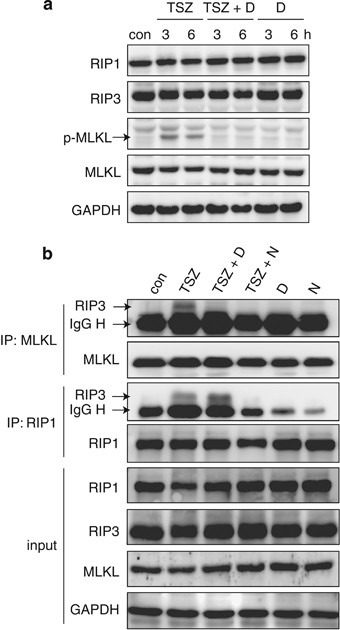
EffectsofdabrafenibontheSer358phosphorylationofMLKLandtheinteractionbetweenRIP3,RIP1orMLKLinHT29cells.(a)Dabrafenib(10鈥?i>渭M)inhibitedtheSer358phosphorylationofMLKLinducedbyTSZattheindicatedtimes.(b)EffectsofdabrafenibontheinteractionbetweenRIP3,RIP1orMLKLinthecellsexposedtotheindicatedcombinationsfor6鈥塰.con,control;D,dabrafenib(10鈥?i>渭M);N,necrostatin-1(10鈥?i>渭M);S,Smacmimetic(100鈥塶M);Z,z-VAD-fmk(20鈥?i>渭M);T,TNF-伪(20鈥塶g/ml).Thedatawererepresentativeofthreeindependentexperiments
FullsizeimageDabrafenibinhibitsRIP3independentlyofitseffectontheB-RaffamilymembersTable1showedthattheinhibitorycapabilityofthosetestedcompoundsincludingdabrafenibonRIP3andotherproteinkinases,respectively,wasnotapparentlycorrelative.Intermsofproliferativeinhibition,B-RafV600E-expressedcolonHT29cellsshowdifferentialsensitivitytoB-RafV600Einhibitorsasevidencedbytheirreportedsensitivitytovemurafenib27butinsensitivitytoGDC-0879;28incontrast,B-RafV600E-expressedmelanomaA375cellsaresimilarlysensitivetoB-RafV600Einhibitorsincludingdabrafenib,vemurafenibandGDC-0879.28However,allthethreeinhibitorscausedsimilarphosphorylationreductionofthedownstreamsignalingproteinsMEKandERKinbothHT29andA375cells(Figure4a).Ontheotherhand,onlydabrafenibreversedTSZ-inducednecroptosisinRIP3-expressedHT29cells,possiblybecausetheother2B-RafV600EinhibitorshavesignificantlyweakRIP3inhibitoryactivity(Table1).A375cellsdidnotexpressRIP3(SupplementaryFigure3a),andthusthetreatmentwithTSZdidnotaffecttheircellviability,whichwasnotaffectedbyaddingdabrafenib,vemurafeniborGDC-0879either(Figure4b,left).SimilarresultswereobservedinRIP3-silenced(shRIP3)Ncells(Figure2c,lowerandFigure4b,middle).SimilarinHT29cells,dabrafenibratherthanvemurafeniborGDC0879preventedTSZ-inducednecroptosisinRIP3-proficientNcellsorshNCNcells(Figures2cand4b(right)).Inaddition,thereducedexpressionofMLKLpartiallyprevented,butwhencombinedwithdabrafenib,completelyreversedthelossoftheHT29cellviabilitycausedbyTRAIL+SZ,possiblybecauseoftheremainingMLKL(Figure4c).Incontrast,thereducedexpressionofB-RafdidnotchangetheTRAIL+SZ-inducedlossofthecellviabilityorthepreventionofdabrafenib(Figure4d).ThedataalsoshowedthatHT29cellswereresistanttodabrafenibalone,justastoGDC-0879.28Thesedatacollectivelyindicatethat(1)bothRIP3inhibitionandB-RafV600Einhibitionareseparable,(2)thebiologicaloutcomesoftheirinhibitionaremutuallyindependentand(3)dabrafenibinhibitsRIP3independentlyofitseffectontheB-Raffamilymembers.
Figure4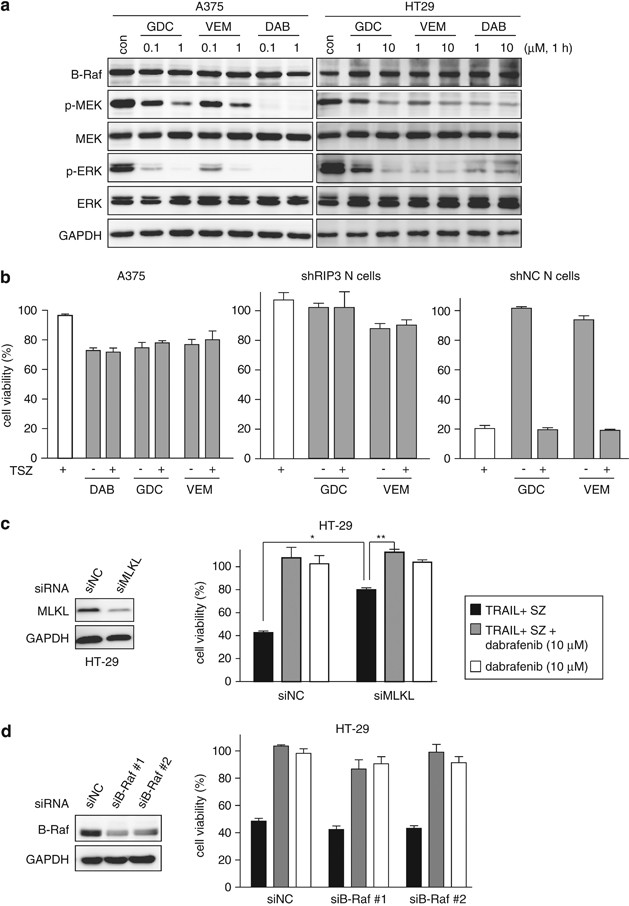
DabrafenibinhibitsRIP3independentlyofitseffectontheB-Raffamilymembers.(a)TheB-RafV600EinhibitorsGDC-0879(GDC),vemurafenib(VEM)anddabrafenib(DAB)inhibitedthephosphorylationofMEKandERKinB-RafV600E-expressedA375cellsandHT29cells.con,control.Thedatawererepresentativeofthreeindependentexperiments.(b)ThecellviabilityofthecellsexposedtoTSZinthepresenceorabsenceoftheindicatedB-RafV600Einhibitorsfor24鈥塰wasexamined.AlltheB-RafV600Einhibitorswereusedat1鈥?i>渭MinA375cellswhileat10鈥?i>渭MinbothshRIP3andshNCNcells.(c)MLKLwassilencedwiththespecificsiRNAinHT29cells.Theproteinlevelswereexaminedbywesternblotting.Thecellviabilityofthecellsexposedtotheindicatedcombinationsfor24鈥塰wasexamined.Dabrafenibwasusedat10鈥?i>渭M.*P=0.00002;**P=0.0002.(d)B-RafwassilencedwiththespecificsiRNAinHT29cells.Theproteinlevelswereexaminedbywesternblotting(left).ThecellviabilityofHT29cellsexposedtotheindicatedcombinationsfor24鈥塰wasexamined
FullsizeimageDabrafenibpreventsacetaminophen-inducednecrosisinnormalhumanhepatocytesAcetaminophentakeninoverdosecancausefatalhepatotoxicityincludingfatalcentrilobularhepaticnecrosis,forwhichRIP3hasbeenshowntoberesponsible.13,14,17InRIP3-expressednormalhumanhepatocyteQSG-7701andHL-7702cells(Figure5a),thetreatmentwith20鈥塵Macetaminophenledtoprogressivelyreducedcellviability,whichwasalleviatedbydabrafenib(Figure5a).Asexpected,dabrafenibobviouslyattenuatedthenecroticmorphologicalchangesofthosecellsexposedtoacetaminophen(Figure5b).ThiscapabilityofdabrafenibwasmuchmorepotentthanthatoftheRIP1inhibitornecrostatin-1(Figure5c).ThehumanRIP3inhibitionbydabrafenibachievedsimilareffectstoRIP3deficiencyinpreventingacetaminophen-inducedhepatocytenecrosis17andethanol-causedliverinjury8inmice.Moreover,RIP3silencingpartiallyreversedtheacetaminophen-inducedlossofthecellviability(Figure5d).Incontrast,necrostatin-1orRIP1silencingdidnotreduceacetaminophen-inducedcelldeathinbothhumanhepatocytecells(Figures5cande)asnecrostatin-1didinmice,17suggestingadifferentialroleofRIP1inhumanandmouse.Inaddition,z-VADincreasedcelldeathinducedbyacetaminophen,whichwaspreventedbydabrafenibpartly(SupplementaryFigure4a);dabrafenibbutnotvemurafenibdecreasedtheacetaminophen-inducedlossofthecellviability(SupplementaryFigure4b).Togetherwiththepreviousreports,8,17ourresultssuggestapotentialpreventiveortherapeuticuseofdabrafenibasaRIP3inhibitorinRIP3-mediatedliverinjury.
Figure5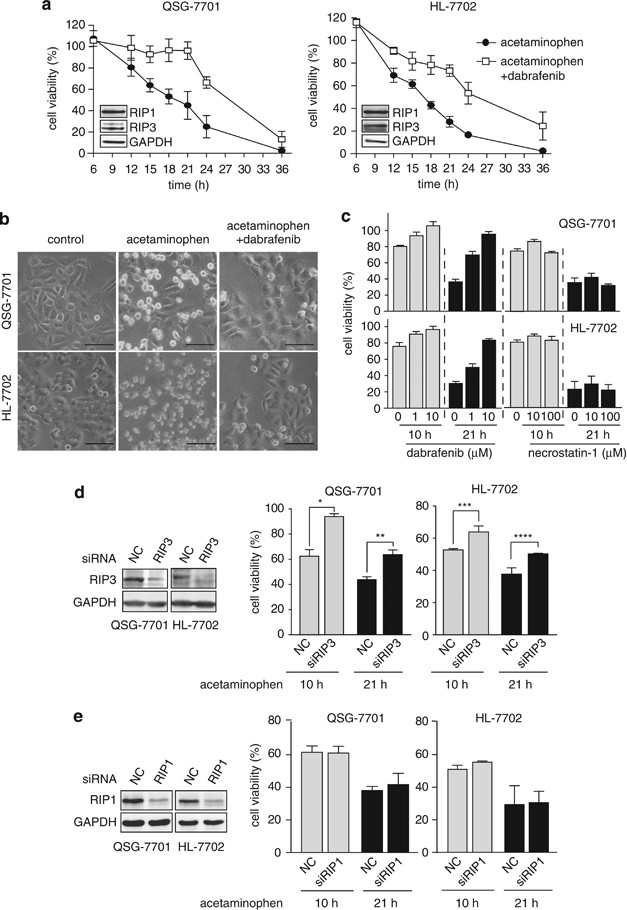
Protectionofdabrafenibfromacetaminophen-inducedcellviabilityreductioninhumanhepatocytes.(a)HumanliverQSG-7701andHL-7702cellsweretreatedwith20鈥塵Macetaminopheninthepresenceorabsenceof10鈥?i>渭Mdabrafenibfortheindicatedtimesandthecellviabilitywasexamined.Insets,thelevelsofRIP1andRIP3proteinsinthecellsweredetectedbywesternblotting.(b)Thecellsexposedto20鈥塵Macetaminophenfortheindicatedtimesinthepresenceorabsenceof10鈥?i>渭Mdabrafenibwereobservedunderaninvertedmicroscopeat脳20magnification.Scalebar,50鈥?i>渭m.(c)Theeffectsofdabrafenibandnecrostatin-1onQSG-7701andHL-7702cellstreatedwith20鈥塵Macetaminophenfor10or21鈥塰wereexamined.(dande)RIP3(d)orRIP1(e)wassilencedwiththespecificsiRNAinQSG-7701cellsandHL-7702cells.Theproteinlevelswereexaminedbywesternblotting.Thecellviabilityoftheindicatedcellsexposedto20鈥塵Macetaminophenattheindicatedtimeswasexamined.*P=0.004;**P=0.005;***P=0.03;****P=0.05.Alltheimagedatawererepresentativeofthreeindependentexperiments
FullsizeimageDabrafenibprotectsmicefromacetaminophen-inducedhepatotoxicityTovalidatethedatafromnormalhumanhepatocyteQSG-7701andHL-7702cells,weexaminedthehepatoprotectiveeffectofdabrafenibinacetaminophen-overdosedmousemodels.The6-htreatmentofmicewithacetaminophen(300鈥塵g/kg)resultedinsignificantliverinjuryasindicatedbythebiochemicalanalysesshowingtheincreaseintheplasmalevelsofalanineaminotransferase,aspartateaminotransferase,interleukin(IL)-1尾andTNF伪andintheliverglutathionedisulfide(GSSG)levels(Figures6aandb;SupplementaryFigure5).Thiswasfurthersupportedbyitshistologicalchangescharacteristicofcentrilobularhepaticnecrosis,peripheralhemorrhageandfocalnecrosisofhepatocytes(Figure6c)andbytheTUNELstainingrevealingtheincreaseinDNAbreaksinthelivercells(Figure6d).Thepretreatmentofmicewithdabrafenib(100鈥塵g/kgor300鈥塵g/kg)apparentlyeasedtheacetaminophen-causedliverinjury(Figure6andSupplementaryFigure5),butanotherB-RafinhibitorvemurafenibthathasveryweakRIP3inhibitoryactivitydidnot(SupplementaryFigure5).Therefore,dabrafenibcanprotectacetaminophen-inducedhepatotoxicityinmiceinadose-dependentmanner.
Figure6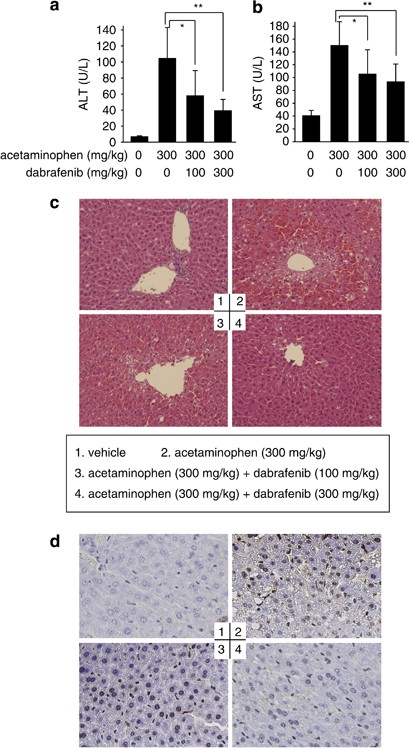
Dabrafeniballeviatesacetaminophen-inducedhepatotoxicityinmice.Miceweretreatedwith300鈥塵g/kgacetaminophen(i.p.),withorwithoutpretreatmentwith300鈥塵g/kgor100鈥塵g/kgdabrafenib(p.o.).Plasmaalanineaminotransferase(ALT)(a)andaspartateaminotransferase(AST)(b)weredetermined.Datawereexpressedasmean卤S.D.;n=10.Ina,*P=0.015and**P=0.0007;andinb,*P=0.03;**P=0.002.(c)Thehistologicalchangesinmouselivertissuesshownbyhematoxylinandeosin(HE)staining.(d)TUNELstainingfornuclearDNAfragmentationinmouselivercells.Thetypicalimageswerecapturedunderanopticalmicroscopeat脳20(c)or脳40(d)magnification
FullsizeimageDiscussionInthisstudy,weestablishedanon-radioactiveRIP3kinaseassayandwithit,foundthatdabrafenibelicitedthemostpotentinhibitiononRIP3amongtheeighttestedRafinhibitors.BycompetitivelybindingofATPtotheenzymeproteindabrafenibinhibitedRIP3withhighselectivityrelativetootherRIPfamilymembers.DabrafenibapparentlyrescuedcellsfromRIP3-mediatednecroptosis,whichwasindependentofitsB-Rafinhibition.Moreover,dabrafeniballeviatedacetaminophen-inducedRIP3-mediatednecroticinjuryineitherhumanlivercellsormouselivertissues.
RIP3-mediatednecroptosishasbeendemonstratedtobeinvolvedinmultiplepathologicalstates.6RIP3knockoutorsilencecouldreverseorpreventsomeofthosediseasesorinjuries,suggestingpotentialpreventiveortherapeuticusesofRIP3inhibitorsintheclinic.TherehavebeenonlytwoRIP3inhibitors(GSK鈥?43andGSK鈥?72)reportedasyet,20butthesetwoinhibitorswerejustusedtoprobetheroleofRIP3inTLR3-inducednecrosis;nodatawereshownabouttheirpreventiveortherapeuticactioninRIP3-associateddiseasesorinjuries.Therefore,dabrafenibisthefirstreportedsmall-moleculeRIP3inhibitorshowingpreventiveortherapeuticactioninRIP3-mediatedpathologicalstates,thatis,theacetaminophen-inducedliverinjury.Dabrafenibhasbeenusedforotherdiseasesintheclinic,indicatingitsacceptablehumansafety.ThisapparentlyraisesthepossibilityofitspreventiveortherapeuticclinicalusesforRIP3-involveddiseasesorinjuriesincludingacetaminophen-overdosedhepatotoxicity.
AlthoughRIP1andRIP3proteinshavesimilarprimarysequencesandRIP1,RIP3andB-Rafproteinshavesimilarconformation,21ourdatashowedthattheRIP1inhibitornecrostatin-1didnotinhibitRIP3.ThetestedB-RafinhibitorsalsoshoweddifferentialRIP3inhibitoryactivities,whichisobviouslyirrelevanttotheirRafinhibitoryactivities.DabrafenibshowedpotentinhibitionagainstbothRIP3andRafkinases.Moreover,ourdatashowedthatdabrafenibinhibitedRIP3independentlyofitseffectontheB-Raffamilymembers.Basedonthestructureofdabrafenib,therefore,carefulstructure-activityrelationshipstudieshelptodifferentiatethemoietiesthatcontributetoitsRIP3inhibitionfromtheonesthatcontributetoitsRafinhibition.TheresultsmaylayanimportantbasisfordevelopmentofhighlyselectiveinhibitorsofRIP3orB-Rafinthefuture.SelectiveRIP3inhibitors,exceptfortheirpotentialapplicationsinRIP3-associatedpathologicalstates,canbeusedasprobestoexploretherolesofRIP3inregulatingcelldeathandtherelatedsignalingtransductionprocesses.
Inaddition,bothdabrafenibandvemurafenibarerecentlyapprovedforthetreatmentofmetastaticmelanomaharboringB-RafV600E.29Dabrafenibshows39-foldmorepotentinhibitionagainstB-RafV600Ethanvemurafenib.However,dabrafenibproducesalittleweakerclinicaltherapeuticeffectandcauseslowerincidenceofcutaneoussquamous-cellcarcinoma(incidence:6%inadabrafenibphaseIIItrialversus26%inavemurafenibphaseIIItrial),acommonsideeffectofB-RafV600Einhibitors.29DabrafenibinhibitedRIP3also27-foldmorepotentlythanvemurafenibasdeterminedbytheluminescentassay(Table1).Thesedifferencesbetweenthe2B-RafV600EinhibitorsappeartosuggestthatRIP3inhibitionmighthavearoleintheirtherapeuticeffectandtoxicity,whichdeservesclarifying.Inthisaspect,selectiveinhibitorsofB-RafagainstRIP3maybealsohelpful.
Finally,theluminescentRIP3kinaseassayweestablishedinthisstudyhasseveraladvantages.IthashighsensitivityequivalenttothewidelyusedradioactiveRIP3kinaseassay.Itisnon-radioactive,andthusfreeofpotentialradioactivecontaminationandrisks.Thisassaycanberuninarelativelysmall(10鈥?i>渭l)systemina384-well-plateformatthatcanmeettherequirementsforhigh-throughputscreeningforsmall-moleculecompounds.TherecombinantRIP3usedthisassayisfull-lengthhumanRIP3,whichensuresthehighrelevanceofthecompound-screeningresultstohumancellsortissues.Inaddition,allothermaterialsorreagentsusedinthisassayarecommonandeasilycommerciallyavailable.AlltheadvantagesindicateapossibilitythatthisRIP3kinaseassayestablishedinthisstudycouldbewidelyusedinthefuture.
MaterialsandMethodsProteinexpressionandpurificationThefull-lengthhumanRIP3cDNAwasamplifiedfromPMD18-T-RIP3plasmid(JiranBio-TechnologyCo.,Ltd.,Shanghai,China)byPCRwiththefollowingprimers:forwardprimer(5鈥?IndexTermTATGCGGCCGCTATGTCGTGCATCAAGTTAT-3鈥?,whichcontainsaNotIsite;reverseprimer(5鈥?IndexTermCGCAAGCTTTTATTTCCCGCTATGATTATACC-3鈥?,whichcontainsaHindIIIsite.ThePCRreaction(4鈥?i>渭l5脳PrimeSTARbuffer,3.2鈥?i>渭lof2.5鈥塵MdNTP,0.5鈥?i>渭lof100鈥?i>渭Mforwardprimer,0.5鈥?i>渭lof100鈥?i>渭Mreverseprimer,1鈥?i>渭lPrimeSTARHSDNApolymerase,1鈥?i>渭lPMD18-T-RIP3(5鈥塶g/渭l)and9.8鈥?i>渭ldoubledistilled(dd)H2O)wasrunat95鈥壜癈for2鈥塵in,followedby30cycles(95鈥壜癈,30鈥塻;60鈥壜癈,30鈥塻;72鈥壜癈,1鈥塵in)and72鈥壜癈,1鈥塵in.
Thefull-lengthhumanRIP3cDNAwasclonedintopFastBacHTBplasmids(Invitrogen,GrandIsland,NY,USA),whichwasmodifiedbyinsertingafragmentofDNAsequenceencodingGSTintotheupstreamofthemultiplecloningsitesoftheprimaryplasmid.Thedigestionconditionswereasfollows:2鈥?i>渭l10脳NEBbufferII,500鈥塶gplasmidorPCRproduct,1鈥?i>渭lHindIII,2鈥?i>渭lNotIandddH2Oto20鈥?i>渭lat37鈥壜癈for4鈥塰.Theligationconditionswereasfollows:1鈥?i>渭lT4ligase,1鈥?i>渭lpFastBacHTB,10鈥?i>渭lPCRproduct,2鈥?i>渭l10脳T4bufferand6鈥?i>渭lddH2Oat16鈥壜癈for4鈥塰.TheligationproductwasthentransformedintoDH5伪cellstoobtaintherecombinantpFastBacHTB-RIP3constructs.ThentheamplifiedrecombinantpFastBacHTB-RIP3constructsweretransformedintoDH10BaccellstogettherecombinantBacmidby鈥榳hite-blueplaqueselection鈥?ThesequenceofthePCRprimerusedtoverifytheRIP3-Bacmidcloneswasasfollows:5鈥?IndexTermTTTGGCCTGTCCACATTTCAG-3鈥?(forward)and5鈥?IndexTermGGTTGGCAACTCAACTTCTCTT-3鈥?(reverse).ThePCRassaywasperformedwithPrimeSTARHSDNApolymeraseaccordingtothemanufacturer鈥檚instructions(TaKaRa,Dalian,China).
TherecombinantRIP3proteinwiththeGSTtagattheNterminalwasexpressedinSf9cellsaccordingtotheprotocoloftheBac-to-Bacbaculovirusexpressionsystem(Invitrogen)andwaspurifiedbyusingglutathione-sepharosebeadsaccordingtothemanufacturer鈥檚instructions(GEHealthcare,Pittsburgh,PA,USA).Theproteinwaselutedinthebuffer(PH7.5)containing50鈥塵MTris-HCl,150鈥塵MNaCl,25%glyceroland10鈥塵Mreducedglutathione.Theelutedproteinwasstoredat鈭?0鈥壜癈.
TheGST-tagproteinwasexpressedandpurifiedusingthesimilarmethodsasshownabove.
QuantitationoftherecombinantRIP3proteinTherecombinantRIP3proteinwasquantifiedbyusingtheGSTtagELISAdetectionkitaccordingtothemanufacturer鈥檚instructions(GenScript,Piscataway,NJ,USA).
Non-radioactiveluminescentRIP3kinaseassaysTheKinase-GloLuminescentKinaseAssaysKit(Promega,Madison,WI,USA)wasusedtoestablishthenon-radioactiveluminescentRIP3kinaseassay.ThepurifiedrecombinantRIP3proteinwasincubatedwithitssubstrateMBP(Invitrogen)inthekinasereactionbuffer(5鈥塵MMOPS,pH=7.2,2.5鈥塵M尾-glycerol-phosphate,5鈥塵MMgCl2,2.5鈥塵MMnCl2,1鈥塵MEGTA,0.4鈥塵MEDTA,0.05鈥塵MDTT)andATPattheindicatedreactionconditions,followedbyaddingthecorrespondingreagentsfromthekitaccordingtothemanufacturer鈥檚instructions.LuminescencewasrecordedwithaPerkinElmerEnVisionMultilabelReader(Perkin-Elmer,Waltham,MA,USA).
Inthisassay,ATPconsumptionduetophosphorylationofthesubstrateMBPcatalyzedbyRIP3wasdefinedassignalorreactionpercentage,whichwascalculatedas[1-luminescence(+MBP)/luminescence(鈭扢BP)]脳100%.Incontrast,ATPconsumptionduetoRIP3-mediatedphosphorylationofnon-MBPproteins(noMBPinthereactionsystem)wasdefinedasnoise,whichwascalculatedas[1-luminescence(+RIP3)/luminescence(鈭扲IP3)]脳100%.WhenevaluatingtheinhibitoryactivityofthetestedcompoundsonRIP3,wedefinedtheinhibitionrateas[1-signal(+compounds)/signal(鈭抍ompounds)]脳100%.Thecompoundconcentrationrequiredfor50%inhibition(IC50)oftheRIP3enzymaticactivitywascalculatedwiththeLogitmethod.
CompoundsDabrafenib,AZ628,regorafenib,PLX4720,vemurafenib,sorafenib,GDC-0879,SB590885andSU11248werepurchasedfromSelleck(Houston,TX,USA).zVAD.fmkwasobtainedfromAbcam(Cambridge,UK),necrostatin-1wasfromTocris(Bristol,UK)andacetaminophenwasfromSigma-Aldrich(St.Louis,MO,USA).Smacmimeticwassynthesizedandpurifiedaspreviouslydescribed.30
CellcultureHumancoloncancerHT29cells,melanomaA375cells,leukemiaU937cellsandinsectSf9cellswereobtainedfromAmericanTypeCultureCollection(Manassas,VA,USA).HumannormalliverQSG-7701andHL-7702celllineswerepurchasedfromtheCellBankoftheChineseAcademyofScienceTypeCultureCollection(Shanghai,China).AcellsandNcellswerekindgiftsfromProfessorJiahuaiHan(XiamenUniversity,Xiamen,China).AllofthehumancellsweremaintainedinRPMI1640mediumexceptHT29cellsthatweremaintainedinMcCoy"s5Amedium,supplementedwith10%fetalbovineserum.AcellsandNcellsweremaintainedinDMEMmedium.Sf9cellwasmaintainedinSF-IIISFMmedium.Allthecelllineswereculturedaccordingtothesuppliers鈥?instructions.AllthecellswerealsoperiodicallyauthenticatedbymorphologicinspectionandtestedMycoplasmacontamination.
Proteins,antibodiesandotherreagentsTNF伪andMBPwerepurchasedfromInvitrogen.FasligandwasobtainedfromSinoBiologicalInc.(Beijing,China).TRAILwaspurchasedfromNovoprotein(Summit,NJ,USA).CommerciallyavailablehumanRIP3proteinwasfromAbcam(Cambridge,UK).HumanRIP1andB-RafantibodieswerepurchasedfromBDBiosciences(FranklinLakes,NJ,USA).HumanMEK,p-MEK,ERKandp-ERKantibodieswerepurchasedfromtheCellSignalingTechnology(Danvers,MA,USA).HumanRIP3antibody,mouseRIP3antibody,mouseGAPDHantibodyandhumanGAPDHantibodywerepurchasedfromSantaCruz(Dallas,TX,USA).HumanMLKLandphospho-MLKL(Ser358)antibodieswereobtainedfromMerckMillipore(Darmstadt,Germany).Theglutathione-sepharosewaspurchasedfromGEHealthcare(Piscataway,NJ,USA)andothercommonreagentswerefromSigma-Aldrich.
InvitrocellviabilityassaysCellswereseededin96-wellplatesatproperdensity.Fornecroptosisinductionassays,TNF伪(T,20鈥塶g/ml),Fasligand(1鈥?i>渭g/ml)orTRAIL(200鈥塶g/ml)plusSmacmimetic(S,100鈥塶M)andz-VAD(Z,20鈥?i>渭M)wereaddedtoinducenecroptosis.Thetestedcompoundswereincubatedwiththecellsexposedtooneoftheabovecombinationsattheindicatedconcentrationsfor24鈥塰.Foracetaminophenhepatotoxicityassays,dabrafenibornecrostatin-1attheindicatedconcentrationswasincubatedwiththecellsexposedtoacetaminophen(20鈥塵M)fortheindicatedtimes.CellviabilitywasthenexaminedbyusingtheCellTiter-GloLuminescentCellViabilityAssaykit(Promega).LuminescencewasrecordedwithanEnVisionMultilabelreader(Perkin-Elmer).
WesternblottingCellularlevelsofproteinsweredeterminedbythestandardwesternblottingusingappropriateantibodies.ProteinswerevisualizedwithanImageQuantLAS4000minisystem(GEHealthcare,Piscataway,NJ,USA)accordingtothemanufacturer鈥檚instructions.
Real-timePCRTotalRNAofthecellswasextractedusingtheRNeasyMiniKit(QIAGENInc.,Valencia,CA,USA).OnemicrogramoftotalRNAwasreverse-transcribedusingaRTreagentkit(TaKaRa).TheresultingcDNAwasamplifiedbyreal-timePCRusingtheSYBRPrimeScriptRT-PCRkit(TaKaRa)intheAppliedBiosystems7500Fastreal-timePCRSystem(AppliedBiosystem,GrandIsland,NY,USA).Theprimersequenceswereasfollows:5鈥?IndexTermAATTCGTGGCTGCGCCTAGAAG-3鈥?(forward)and5鈥?IndexTermTCGTGCAGGTAAAACATCCCA-3鈥?(reverse)forRIP3;5鈥?IndexTermGGATGCAGAAGGAGATCACTG-3鈥?(forward);and5鈥?IndexTermCGATCCACACGGAGTACTTG-3鈥?(reverse)for尾actin.TherelativequantificationofRIP3mRNAlevelswasautomaticallyanalyzedbythesoftwareofthePCRsystem.
CellstainingForHochest33342/PIstaining,cellswereincubatedwithHochest33342/PIat37鈥壜癈for30鈥塵inandanalyzedinINCellAnalyzer2000(GEHealthcare)accordingtothemanufacturer鈥檚instructions.ForFACS,cellsweretrypsinized,collectedbycentrifugation,washedoncewithPBSbufferandthenresuspendedinPBScontaining5鈥?i>渭g/mlPI.ThelevelsofPIincorporationwerequantifiedwithBDFACSCalibur(BD,FranklinLakes,NJ,USA).
SmallinterferingRNA(siRNA)Cellsweretransfectedwith100鈥塶MsiRNAusingRNAiMax(Invitrogen)accordingtothemanufacturer鈥檚instructions.siRNAsequenceswereasfollows:5鈥?IndexTermUGCAGUCUCUUCAACUUGAATT-3鈥?forRIP1;5(#1)5鈥?IndexTermAGAAUUGGAUCUGGAUCAU-3鈥?(#2)5鈥?IndexTermAAAGAAUUGGAUCUGGAUCAU-3鈥?forB-Raf;5鈥?IndexTermTGAGTTACCAGGAAGTTTGTT-3鈥?forMLKL;315鈥?IndexTermUAACUUGACGCACGACAUCAGGCUGUU-3鈥?forRIP3;5and5鈥?IndexTermUUCUCCGAACGUGUCACGUTT-3鈥?asnegativecontrol.ThesiRNAswereobtainedfromShanghaiGenePharmaCo.Ltd(Shanghai,China).
RIP3-silencedNcellsTheexpressionofRIP3wassilencedinNcellswiththespecificshort-hairpinRNAs(shRNAs)onalentivirusvector(pLV-H1-EF1伪-puro-RIP3-shRNA,akindgiftfromProfessorJiahuaiHan,XiamenUniversity,Xiamen,China).ThesequenceofRIP3shRNAis5鈥?IndexTermAAAAGCTGAGTTGGTAGACAAGATTGGATCCAACGACTCAACCATCTGTTCTTTTTTTTT-3鈥?ThesequenceofthecontrolshRNAis5鈥?IndexTermAAAAGCAGTTATCTGGAAGATCAGGTTGGATCCAACCTGATCTTCCAGATAACTGC-3鈥?TheshRNA-containedlentiviruswaspackagedinHEK293FTcellsandwasusedtoinfectNcells.TheRIP3-silencedNcellswereselectedbyaddingtheculturemediumcontaining1鈥?i>渭g/mlpuromycin.3
SurfaceplasmonresonanceassayThebindingaffinityofdabrafenibornecrostatin-1toRIP3wasdeterminedbyusingBiacoreT200(GEHealthcare,Piscataway,NJ,USA).ThepurifiedrecombinantRIP3proteinwasimmobilizedtotheCM5chipsurface(GEHealthcare)accordingtoastandardamine-couplingprocedurein10鈥塵Msodiumacetate(pH4.5)usingHBS-EP(10鈥塵MHEPES(pH7.4),150鈥塵MNaCl,3鈥塵MEDTA,0.05%(v/v)surfactantP20)astherunningbuffer.Dabrafenibandnecrostatin-1wereseriallydilutedandinjectedontothesensorchipataflowrateof30鈥?i>渭l/minfor120鈥塻(contactphase),followedby120鈥塻ofthebufferflow(dissociationphase).TheKdvalueofdabrafenibwasdeterminedwiththeBIAevaluationsoftware(GEHealthcare).32
HomologymodelingandmoleculardockingBasedonthesimilarityofdabrafenibtotheligandinB-Rafstructure(PDBID:3SKC),weselectedthe3SKCasthetemplatetobuildthethree-dimensionalstructureofhumanRIP3.ThesoftwareModeller(version9.12)33wasusedtoperformthehomologymodelingandrefinementwiththedefaultparameters.Andtheamino-acidresidueswerenumberedinthisstudyaccordingthesequenceNP_006862.
TheliganddabrafenibwasbuiltinMaestro(Schr枚dingersoftware,http://www.schrodinger.com/),andrefinedwiththeMMFF94forcefield.TheB-Raf(3SKC)andmodeledhumanRIP3structureswerepreparedwithautodocktoolstoaddthehydrogensandassignchargesandsavedasthepdbqtfileformat.Dabrafenibwasalsopreparedwiththeautodocktool.ThenthesoftwareVina(version1.1)34wasusedtodockdabrafenibintotheATP-bindingsitesofB-RafandRIP3.Totally,10runswereperformedforeachprotein,andthelowestenergyconformationwasselectedforthedetailedanalysisofinteractionpatterns.
ImmunoprecipitationHT-29cellsat90%confluencegrownwerewashedoncewithPBSandlysedfor30鈥塵inoniceintheNP-40lysisbuffer(Beyotime,Jiangsu,China).Celllysateswerethencentrifugedat12鈥?00脳gfor20鈥塵in.Thesolublefractionwascollected,andtheproteinconcentrationwasdeterminedbyusingthePierceBCAProteinAssaykit(ThermoFisherScientific,Waltham,MA,USA).Next,1鈥塵goftheextractedproteininthelysisbufferwasimmunoprecipitatedovernightwithanti-MLKLoranti-RIP1antibodyat4鈥壜癈andthenwithproteinA+Gagarosebeads(Beyotime)foranother4鈥塰.Afterthat,theproteinA+Gagarosebeadswerewashedthreetimeswiththelysisbuffer.Thebeadswerethenboiledin1%SDSloadingbufferforwesternblottingwiththeindicatedantibodies.
AnimalexperimentsSpecificpathogen-freemaleC57Bl/6Jmice(weight18鈥?2鈥塯)weresuppliedfromtheShanghaiLaboratoryAnimalCenter,ChineseAcademyofSciences.Theanimalswerehoused.AllexperimentsabidedbyinstitutionalethicalguidelinesoftheAnimalCareandUseCommittee(ShanghaiInstituteofMateriaMedica,ChineseAcademyofSciences,China).Fordrugadministration,acetaminophenwasdissolvedinnormalsaline,whereasdabrafenibandvemurafenibweredissolvedinpH8.0distilledwatercontaining0.5%HPMCand0.2%Tween80.Overnight-fastedmiceweregivendabrafenib(300鈥塵g/kgor100鈥塵g/kg)orvemurafenib(300鈥塵g/kg)byoralgavage1鈥塰beforetheintraperitonealinjectionof300鈥塵g/kgacetaminophen.Themicewerekilled6鈥塰posttheacetaminophentreatment.PlasmaalanineaminotransferaseandaspartateaminotransferaseweremeasuredwithaCobasC501ChemistryAnalyzer(Roche,Basel,Switzerland).PlasmaIL-1尾andTNF-伪weremeasuredbyusingthemouseIL-1尾ELISAkitandthemouseTNF-伪ELISAkit(MultiSciences,Bellingham,WA,USA),respectively.LiverGSSGwasmeasuredbyusingaGSSGAssaykit(Beyotime).Toevaluatethechangesinliverhistology,sectionsofparaformaldehyde-fixedlivertissueswerestainedwithhematoxylinandeosinandphotographedunderanopticalmicroscope.ThestandardTUNELstainingwascarriedouttoevaluatetheDNAbreaksinlivercells.
StatisticalanalysisAllthedata,ifapplicable,wereexpressedasmean卤S.D.ComparisonbetweentwogroupswasperformedwiththeStudent鈥檚t-test.P0.05wasconsideredstatisticallysignificant.Allthedataexpressedasmean卤S.D.werefromthreeindependentexperimentsunlessotherwisespecified.
glutathionedisulfide
References1ChristoffersonDE,YuanJ.Necroptosisasanalternativeformofprogrammedcelldeath.CurrOpinCellBiol2010;22:263鈥?68.
CASPubMedPubMedCentralArticleGoogleScholar2VandenabeeleP,GalluzziL,VandenBergheT,KroemerG.Molecularmechanismsofnecroptosis:anorderedcellularexplosion.NatRevMolCellBiol2010;11:700鈥?14.
CASArticleGoogleScholar3ZhangDW,ShaoJ,LinJ,ZhangN,LuBJ,LinSCetal.RIP3,anenergymetabolismregulatorthatswitchesTNF-inducedcelldeathfromapoptosistonecrosis.Science2009;325:332鈥?36.
CASPubMedPubMedCentralArticleGoogleScholar4HeS,WangL,MiaoL,WangT,DuF,ZhaoLetal.Receptorinteractingproteinkinase-3determinescellularnecroticresponsetoTNF-alpha.Cell2009;137:1100鈥?111.
CASArticleGoogleScholar5ChoYS,ChallaS,MoquinD,GengaR,RayTD,GuildfordMetal.Phosphorylation-drivenassemblyoftheRIP1-RIP3complexregulatesprogrammednecrosisandvirus-inducedinflammation.Cell2009;137:1112鈥?123.
CASPubMedPubMedCentralArticleGoogleScholar6MoriwakiK,ChanFK.RIP3:amolecularswitchfornecrosisandinflammation.GenesDev2013;27:1640鈥?649.
CASPubMedPubMedCentralArticleGoogleScholar7KaiserWJ,UptonJW,LongAB,Livingston-RosanoffD,Daley-BauerLP,HakemRetal.RIP3mediatestheembryoniclethalityofcaspase-8-deficientmice.Nature2011;471:368鈥?72.
CASPubMedPubMedCentralArticleGoogleScholar8RoychowdhuryS,McMullenMR,PisanoSG,LiuX,NagyLE.Absenceofreceptorinteractingproteinkinase3preventsethanol-inducedliverinjury.Hepatology2013;57:1773鈥?783.
CASPubMedPubMedCentralArticleGoogleScholar9WelzPS,WullaertA,VlantisK,KondylisV,Fernandez-MajadaV,ErmolaevaMetal.FADDpreventsRIP3-mediatedepithelialcellnecrosisandchronicintestinalinflammation.Nature2011;477:330鈥?34.
CASArticleGoogleScholar10TrichonasG,MurakamiY,ThanosA,MorizaneY,KayamaM,DebouckCMetal.Receptorinteractingproteinkinasesmediateretinaldetachment-inducedphotoreceptornecrosisandcompensateforinhibitionofapoptosis.ProcNatlAcadSciUSA2010;107:21695鈥?1700.
CASArticleGoogleScholar11MurakamiY,MatsumotoH,RohM,SuzukiJ,HisatomiT,IkedaYetal.Receptorinteractingproteinkinasemediatesnecroticconebutnotrodcelldeathinamousemodelofinheriteddegeneration.ProcNatlAcadSciUSA2012;109:14598鈥?4603.
CASArticleGoogleScholar12LinJ,LiH,YangM,RenJ,HuangZ,HanFetal.AroleofRIP3-mediatedmacrophagenecrosisinatherosclerosisdevelopment.CellRep2013;3:200鈥?10.
CASPubMedArticleGoogleScholar13JamesLP,MayeuxPR,HinsonJA.Acetaminophen-inducedhepatotoxicity.DrugMetabDispos2003;31:1499鈥?506.
CASArticleGoogleScholar14AntoineDJ,DearJW,LewisPS,PlattV,CoyleJ,MassonMetal.Mechanisticbiomarkersprovideearlyandsensitivedetectionofacetaminophen-inducedacuteliverinjuryatfirstpresentationtohospital.Hepatology2013;58:777鈥?87.
CASPubMedPubMedCentralArticleGoogleScholar15LarsonAM,PolsonJ,FontanaRJ,DavernTJ,LalaniE,HynanLSetal.Acetaminophen-inducedacuteliverfailure:resultsofaUnitedStatesmulticenter,prospectivestudy.Hepatology2005;42:1364鈥?372.
CASPubMedArticleGoogleScholar16ZhaoP,WangC,LiuW,ChenG,LiuX,WangXetal.Causesandoutcomesofacuteliverfailureinchina.PLoSOne2013;8:e80991.
PubMedPubMedCentralArticleGoogleScholar17RamachandranA,McGillMR,XieY,NiHM,DingWX,JaeschkeH.Receptorinteractingproteinkinase3isacriticalearlymediatorofacetaminophen-inducedhepatocytenecrosisinmice.Hepatology2013;58:2099鈥?108.
CASPubMedArticleGoogleScholar18VucurM,ReisingerF,GautheronJ,JanssenJ,RoderburgC,CardenasDVetal.RIP3inhibitsinflammatoryhepatocarcinogenesisbutpromotescholestasisbycontrollingcaspase-8-andJNK-dependentcompensatorycellproliferation.CellRep2013;4:776鈥?90.
CASPubMedArticleGoogleScholar19HeJX,WangYQ,FengJM,LiJX,XuL,LiXHetal.DifferentialsensitivityofRIP3-proficientanddeficientmurinefibroblaststocamptothecinanticancerdrugs.ActaPharmacolSin2012;33:426鈥?28.
CASPubMedPubMedCentralArticleGoogleScholar20KaiserWJ,SridharanH,HuangC,MandalP,UptonJW,GoughPJetal.Toll-likereceptor3-mediatednecrosisviaTRIF,RIP3,andMLKL.JBiolChem2013;288:31268鈥?1279.
CASPubMedPubMedCentralArticleGoogleScholar21DegterevA,HitomiJ,GermscheidM,Ch"enIL,KorkinaO,TengXetal.IdentificationofRIP1kinaseasaspecificcellulartargetofnecrostatins.NatChemBiol2008;4:313鈥?21.
CASPubMedPubMedCentralArticleGoogleScholar22XieT,PengW,LiuY,YanC,MakiJ,DegterevAetal.StructuralbasisofRIP1inhibitionbynecrostatins.Structure2013;21:493鈥?99.
CASPubMedArticleGoogleScholar23WenglowskyS,AhrendtKA,BuckmelterAJ,FengB,GloorSL,GradlSetal.PyrazolopyridineinhibitorsofB-RafV600E.Part2:structure-activityrelationships.BioorgMedChemLett2011;21:5533鈥?537.
CASPubMedArticleGoogleScholar24DegterevA,HuangZ,BoyceM,LiY,JagtapP,MizushimaNetal.Chemicalinhibitorofnonapoptoticcelldeathwiththerapeuticpotentialforischemicbraininjury.NatChemBiol2005;1:112鈥?19.
CASPubMedPubMedCentralArticleGoogleScholar25MotzerRJ,HutsonTE,CellaD,ReevesJ,HawkinsR,GuoJetal.Pazopanibversussunitinibinmetastaticrenal-cellcarcinoma.NEnglJMed2013;369:722鈥?31.
CASPubMedArticleGoogleScholar26SunL,WangH,WangZ,HeS,ChenS,LiaoDetal.Mixedlineagekinasedomain-likeproteinmediatesnecrosissignalingdownstreamofRIP3kinase.Cell2012;148:213鈥?27.
CASArticleGoogleScholar27YangH,HigginsB,KolinskyK,PackmanK,BradleyWD,LeeRJetal.AntitumoractivityofBRAFinhibitorvemurafenibinpreclinicalmodelsofBRAF-mutantcolorectalcancer.CancerRes2012;72:779鈥?89.
CASPubMedArticleGoogleScholar28HoeflichKP,HerterS,TienJ,WongL,BerryL,ChanJetal.AntitumorefficacyofthenovelRAFinhibitorGDC-0879ispredictedbyBRAFV600Emutationalstatusandsustainedextracellularsignal-regulatedkinase/mitogen-activatedproteinkinasepathwaysuppression.CancerRes2009;69:3042鈥?051.
CASPubMedArticleGoogleScholar29LukeJJ,HodiFS.Ipilimumab,vemurafenib,dabrafenib,andtrametinib:synergisticcompetitorsintheclinicalmanagementofBRAFmutantmalignantmelanoma.Oncologist2013;18:717鈥?25.
CASPubMedPubMedCentralArticleGoogleScholar30LiL,ThomasRM,SuzukiH,DeBrabanderJK,WangX,HarranPG.AsmallmoleculeSmacmimicpotentiatesTRAIL-andTNFalpha-mediatedcelldeath.Science2004;305:1471鈥?474.
CASArticleGoogleScholar31WangZ,JiangH,ChenS,DuF,WangX.ThemitochondrialphosphatasePGAM5functionsattheconvergencepointofmultiplenecroticdeathpathways.Cell2012;148:228鈥?43.
CASArticleGoogleScholar32WenWW,XieS,XinXL,GengMY,DingJ,ChenY.OligomannuraratesulfateinhibitsCXCL12/SDF-1-mediatedproliferationandinvasionofhumantumorcellsinvitro.ActaPharmacolSin2013;34:1554鈥?559.
CASPubMedPubMedCentralArticleGoogleScholar33EswarN,WebbB,Marti-RenomMA,MadhusudhanM,EramianD,ShenMyetal.ComparativeproteinstructuremodelingusingModeller.CurrProtocBioinformatics2006:1鈥?0Chapter5,Unit5.6.
34TrottO,OlsonAJ.AutoDockVina:improvingthespeedandaccuracyofdockingwithanewscoringfunction,efficientoptimization,andmultithreading.JComputChem2010;31:455鈥?61.
CASPubMedPubMedCentralGoogleScholar35LaquerreS,ArnoneM,MossK,YangJ,FisherK,Kane-CarsonLetal.AselectiveRafkinaseinhibitorinducescelldeathandtumorregressionofhumancancercelllinesencodingB-RafV600Emutation.MolCancerTher2009;8:B88.
ArticleGoogleScholar36KhazakV,AstsaturovI,SerebriiskiiIG,GolemisEA.SelectiveRafinhibitionincancertherapy.ExpertOpinTherTargets2007;11:1587鈥?609.
CASPubMedPubMedCentralArticleGoogleScholar37WilhelmSM,DumasJ,AdnaneL,LynchM,CarterCA,SchutzGetal.Regorafenib(BAY73-4506):aneworalmultikinaseinhibitorofangiogenic,stromalandoncogenicreceptortyrosinekinaseswithpotentpreclinicalantitumoractivity.IntJCancer2011;129:245鈥?55.
CASPubMedArticleGoogleScholar38TsaiJ,LeeJT,WangW,ZhangJ,ChoH,MamoSetal.DiscoveryofaselectiveinhibitorofoncogenicB-Rafkinasewithpotentantimelanomaactivity.ProcNatlAcadSciUSA2008;105:3041鈥?046.
CASArticleGoogleScholar39BollagG,HirthP,TsaiJ,ZhangJ,IbrahimPN,ChoHetal.ClinicalefficacyofaRAFinhibitorneedsbroadtargetblockadeinBRAF-mutantmelanoma.Nature2010;467:596鈥?99.
CASPubMedPubMedCentralArticleGoogleScholar40WilhelmSM,CarterC,TangL,WilkieD,McNabolaA,RongHetal.BAY43-9006exhibitsbroadspectrumoralantitumoractivityandtargetstheRAF/MEK/ERKpathwayandreceptortyrosinekinasesinvolvedintumorprogressionandangiogenesis.CancerRes2004;64:7099鈥?109.
CASArticleGoogleScholar41WongH,BelvinM,HerterS,HoeflichKP,MurrayLJ,WongLetal.Pharmacodynamicsof2-[4-[(1E)-1-(hydroxyimino)-2,3-dihydro-1H-inden-5-yl]-3-(pyridine-4-yl)-1H-pyrazol-1-yl]ethan-1-ol(GDC-0879),apotentandselectiveB-Rafkinaseinhibitor:understandingrelationshipsbetweensystemicconcentrations,phosphorylatedmitogen-activatedproteinkinasekinase1inhibition,andefficacy.JPharmacolExpTher2009;329:360鈥?67.
CASPubMedArticleGoogleScholar42KingAJ,PatrickDR,BatorskyRS,HoML,DoHT,ZhangSYetal.DemonstrationofagenetictherapeuticindexfortumorsexpressingoncogenicBRAFbythekinaseinhibitorSB-590885.CancerRes2006;66:11100鈥?1105.
CASPubMedArticleGoogleScholarDownloadreferences
AcknowledgementsWethankProfessorJia-HuaiHan(XiamenUniversity,Xiamen,China)forhiskindgiftsofAcells,NcellsandtheplasmidspLV-H1-EF1伪-puro-RIP3-shRNA(shRIP3)andpLV-H1-EF1伪-puro-NC(shNC).ThisworkwassupportedbygrantsfromtheNationalNaturalScienceFoundationofChina(No.81373446,No.81025020andNo.81321092),theNationalBasicResearchProgramofChina(No.2012CB932502),theNationalScienceandTechnologyMajorProjectofChina(No.2012ZX09301-001-002),the鈥業nterdisciplinaryCooperationTeam鈥?ProgramforScienceandTechnologyInnovationoftheChineseAcademyofSciencesandtheStateKeyLaboratoryofDrugResearch(No.SIMM1203ZZ-0103).
AuthorinformationAffiliationsDivisionofAntitumorPharmacology,StateKeyLaboratoryofDrugResearch,ShanghaiInstituteofMateriaMedica,ChineseAcademyofSciences,555ZuChongZhiRoad,ZhangJiangHi-TechPark,Shanghai,201203,ChinaJ-XLi,聽J-MFeng,聽YWang,聽X-HLi,聽YSu,聽Y-YShen,聽YChen,聽JDing聽聽Z-HMiaoDepartmentofMedicinalChemistry,StateKeyLaboratoryofDrugResearch,ShanghaiInstituteofMateriaMedica,ChineseAcademyofSciences,555ZuChongZhiRoad,ZhangJiangHi-TechPark,Shanghai,201203,ChinaX-XChen,聽BXiong聽聽C-HYangAuthorsJ-XLiViewauthorpublicationsYoucanalsosearchforthisauthorinPubMedGoogleScholarJ-MFengViewauthorpublicationsYoucanalsosearchforthisauthorinPubMedGoogleScholarYWangViewauthorpublicationsYoucanalsosearchforthisauthorinPubMedGoogleScholarX-HLiViewauthorpublicationsYoucanalsosearchforthisauthorinPubMedGoogleScholarX-XChenViewauthorpublicationsYoucanalsosearchforthisauthorinPubMedGoogleScholarYSuViewauthorpublicationsYoucanalsosearchforthisauthorinPubMedGoogleScholarY-YShenViewauthorpublicationsYoucanalsosearchforthisauthorinPubMedGoogleScholarYChenViewauthorpublicationsYoucanalsosearchforthisauthorinPubMedGoogleScholarBXiongViewauthorpublicationsYoucanalsosearchforthisauthorinPubMedGoogleScholarC-HYangViewauthorpublicationsYoucanalsosearchforthisauthorinPubMedGoogleScholarJDingViewauthorpublicationsYoucanalsosearchforthisauthorinPubMedGoogleScholarZ-HMiaoViewauthorpublicationsYoucanalsosearchforthisauthorinPubMedGoogleScholarCorrespondingauthorCorrespondencetoZ-HMiao.
EthicsdeclarationsCompetinginterestsTheauthorsdeclarenoconflictofinterest.
AdditionalinformationEditedbyAOberst
SupplementaryInformationaccompaniesthispaperonCellDeathandDiseasewebsite
SupplementaryinformationSupplementaryFigureS1(PDF1190kb)SupplementaryFigureS2(PDF398kb)SupplementaryFigureS3(PDF5729kb)SupplementaryFigureS4(PDF353kb)SupplementaryFigureS5(PDF341kb)SupplementaryInformation(DOC41kb)RightsandpermissionsCellDeathandDiseaseisanopen-accessjournalpublishedbyNaturePublishingGroup.ThisworkislicensedunderaCreativeCommonsAttribution-NonCommercial-ShareAlike3.0UnportedLicense.Theimagesorotherthirdpartymaterialinthisarticleareincludedinthearticle鈥檚CreativeCommonslicense,unlessindicatedotherwiseinthecreditline;ifthematerialisnotincludedundertheCreativeCommonslicense,userswillneedtoobtainpermissionfromthelicenseholdertoreproducethematerial.Toviewacopyofthislicense,visithttp://creativecommons.org/licenses/by-nc-sa/3.0/
ReprintsandPermissions
Aboutthisarticle Citethisarticle
Li,J.,Feng,J.,Wang,Y.etal.TheB-RafV600EinhibitordabrafenibselectivelyinhibitsRIP3andalleviatesacetaminophen-inducedliverinjury.CellDeathDis5,e1278(2014).https://doi.org/10.1038/cddis.2014.241
Downloadcitation
Received:19January2014
Revised:22April2014
Accepted:23April2014
Published:05June2014
IssueDate:June2014
DOI:https://doi.org/10.1038/cddis.2014.241