

企业QQ

官方微信

AEnvironmentalBiologyGroup,ResearchSchoolofBiologicalSciences,InstituteofAdvancedStudies,AustralianNationalUniversity,GPOBox475,Canberra,ACT2601,Australia.
BCurrentaddress:LaboratoireStructureetMétabolismedesPlantes,Bat.630,InstitutdeBiotechnologiedesPlantes,CentreScientifiqued’Orsay,UniversitéParisXI,91405OrsayCedex,France.
Correspondingauthor.Email:guillaume.tcherkez@ese.u-psud.fr
FunctionalPlantBiology32(4)277-291https://doi.org/10.1071/FP04211
Submitted:12November2004Accepted:7March2005Published:26April2005
Carbonisotopeeffectsofenzymesinvolvedinprimarycarbonmetabolismarekeyparametersinourunderstandingofplantmetabolism.Nevertheless,someofthemarepoorlyknownbecauseofthelackofinvitroexperimentaldataonpurifiedenzymes.Somestudieshavefocusedontheoreticalpredictionsofisotopeeffects.HereweshowhowquantumchemicalcalculationscanbeadaptedforcalculationofisotopeeffectsfortheRubisco-catalysedcarboxylationandoxygenationreactionsandthecitratesynthasereaction.TheintrinsicisotopeeffectofthecarboxylationbyRubiscoappearstobemuchsmallerthanpreviouslythought,beingclosetotheoverallisotopeeffectofthereactionthatis,between25and30permil.Thesameappliestotheenzymecitratesynthase,thatcatalysesthefirststepoftheKrebscycle,withanisotopeeffectofaround23permil.Combinedwiththeisotopeeffectsofequilibriumreactionscalculatedwithβ-factors,theKrebscyclethenhasanoverallisotopeeffectthatdepletesorganicacidsin13C.
Keywords:carbonisotopes,carbonmetabolism,carboxylation,citratesynthase,enzymes,oxygenation,Rubisco.
WeacknowledgevaluablediscussionswithDrJillGreadyandDrJAndrews.GDFalsowishestoacknowledgetheAustralianResearchCouncilforitssupportthroughaDiscoveryGrant.
Therelationshipbetweentheisotopeeffectandtherateconstantsofthestepsofthereactioncanbesimplyobtainedusingthegeneralexpressionoftherateofthereaction.Themechanismis:

whereCandE–KCAdenoteCO2andthesix-carbonintermediate,respectively.Therateoftheoverallreactionwith12CO2and13CO2iscalculatedconsideringthatthetwoisotopomerscompeteforcarboxylation.AsimilarsystemhasalreadybeenstudiedbyFarquhar(1979)withCO2andoxygen(competitionbetweencarboxylationandoxygenation).IfRuBPisnotlimiting,therateis:

whereOistheoxygenconcentration,andKCandKOaretheapparentMichaelisconstantsforCO2andO2.Vcisthemaximumvelocityofthecarboxylase.Similarly,withtwo12Cand13C-isotopomersofCO2,wehave,neglectingoxygenation:

andthesymmetricalexpressionfor13CO2.Theratioofthevelocitiesisthen:

Dividingeachsideby12C / 13C,wehavetheoverallisotopeeffectofthereaction:
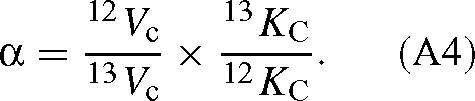
ThevaluesofKCandVcare(derivedfromtheappendixofFarquhar1979):


where[E]0isthetotalenzymesiteconcentration.SubstitutingtheVcandKCvaluesintoeqn(A4)gives:
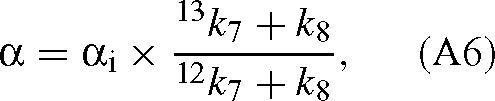
whereαi(=12k6 / 13k6)isthe‘intrinsic’isotopeeffect,thatis,theisotopeeffectofthecarboxylationstep.k8isassumedtobesimilarwithbothisotopesbecausethecorrespondingstep(hydrationandcleavageoftheC6intermediate)doesnotinvolvethecarbonatominheritedfromCO2.ThisresultisnotmodifiedwhenRuBPislimitingorwhentheoxygenationofRuBPistakenintoaccount.IfRuBPislimiting,thevelocityis(Farquhar1979):

whereKa′istheapparentMichaelisconstantforRuBPandAistheconcentrationofRuBP.Itisthesamefor13Cand12Csothatitcancelsoutineqn(A3).Whenoxygenationisadded,thedenominatorofvineqn(A2)hastheadditionaltermO / KO,andithasnoeffectontheratioofeqn(A4).
Equation(A6)canbere-writtenwiththerelationship12k7=(1+ϵ7)13k7(ϵ7isthediscriminationassociatedwithdecarboxylation)andsubstitutingk7usingeqn(A5)asfollows:

whereCisthe(overall)carbondioxideconcentration.TheconcentrationCishereaddedinboththenumeratorandthedenominatorinordertorecallthatk6Chasthesamedimensionask8,andKChasthedimensionofaconcentration.
TheoxygenisotopeeffectthatoccurswhentheO(O2)–C2(RuBP)isformed,asgivenbyeqn(4)isnotequaltotheisotopeeffectthatwouldbemeasuredusingtheoverallisotoperatioinO2comparedwiththatoftheoxygenthatisfixedtotheC-2ofRuBP.ThisisbecauseofthesymmetryoftheO2molecule.Thereactionisdescribedasfollows,whereforclarity,theoxygenatomsarelabelledwithnumbers:

Thefractionationgivenbyeqn(4)is:

whiletheisotopefractionationthatwouldbemeasuredisasfollows:

Buttheoxygenatomnumber1isnotinvolvedbythebondconsideredandsoisnotsubjectedtoanyisotopeeffect.Sowehaveδ(1)=δ(1′)andthesimplerelationship:Δ′=Δ / 2.Astheisotopeeffectisgivenbyα=Δ−1,wehaveα′=1+(α−1) / 2.
Weassumeherethefollowingreversiblereaction,withthereactantsAandtheproductB:
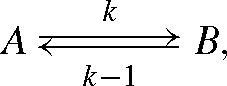
wheretherateconstantsoftheforwardandbackwardreactionsarekandk–1,respectively.Forthe12Cand13Cisotopes,wehave:k12,k13andk–112andk–113.Massbalanceequationsaresuchthat:

whichistrueforeachisotope:A12+B12=A012andsimilarlyfor13C.Withafirstordermechanism,wehavethefollowingdifferentialequation:

Thesameappliesto13C:

Thesolutionsof(A10)and(A11)areexponentialfunctions.For12C,wehave:

wherezandwareobtainedatt=0sothat:

andthesameforA13.CombiningEqns(A9)and(A12),wehave:

andsimilarlyforB13.Theisotopeeffectisdefinedbytheisotoperatioofthereactantsdividedbythatoftheproducts,thatis,witheqns(A12)and(A13):

Whent→0,RA / RBtendstowardsk12 / k13andwhent→+∞,ittendstowards:
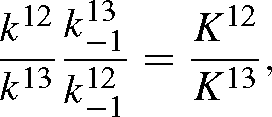
astheexponentialtermtendstozero.